
You've made a stack of granny squares. Some are a little bigger, some curl at the corners, and one looks more like a rhombus than a square. Before you reach for the needle to join them, there's one step that makes the biggest difference to how the finished piece looks: blocking.
What blocking does
Blocking means wetting your crochet, pinning it to the shape and size you want, and letting it dry there. As it dries, the yarn relaxes and "remembers" the new shape. Stitches even out, lace opens up, curled edges flatten and corners turn crisp.
For anything made of motifs (granny squares, hexagons, coasters, doilies) blocking before joining matters most. When every square is pinned to exactly the same size, the stitches along each edge line up stitch for stitch, so your seams are straight and your blanket or bag lies flat instead of rippling. You might give the finished piece a light block again after the border, but the hard work is done.
What you need
- Blocking mats: interlocking foam tiles, like the grey ones in the photo. A folded towel on a spare bed works in a pinch.
- Rust-proof pins: T-pins or blocking pins. Rust-proof matters: ordinary pins can leave orange marks on damp yarn.
- A spray bottle of plain cool water.
- A tape measure, or a mat with a printed grid.
The method: pin it flat, spritz, let it dry
- Measure your squares. Pick a target size, usually that of your average square rather than the biggest or smallest.
- Pin the corners first. Lay a square right side up and put a pin through each corner to the target size. Then add pins along each edge, easing the stitches so the sides are straight. Pin the stitches, not the gaps between them.
- Spritz with water until the square is evenly damp but not dripping.
- Let it dry completely, often overnight and sometimes up to a day, before you unpin. Unpin too early and it'll spring back.
Tip: mark your target size on the mat once, and you can block a whole batch of squares side by side.
Wool, cotton or acrylic?
- Wool and other animal fibres block beautifully. Spray blocking works well; for a dramatic change (like opening up lace), soak the piece in cool water, gently squeeze out the excess in a towel, then pin. Never wring it.
- Cotton, the classic choice for coasters, dishcloths and doilies, takes well to spray or wet blocking and holds a crisp shape once dry.
- Acrylic only softens a little with water. Spray blocking evens out stitches, but for a stronger result some crocheters use gentle steam: hold the iron or steamer above the pinned piece without touching it. Heat changes acrylic permanently, so test on a spare square first and never press.
Whatever the fibre, check the yarn label for care instructions first.
Where you'll notice it most
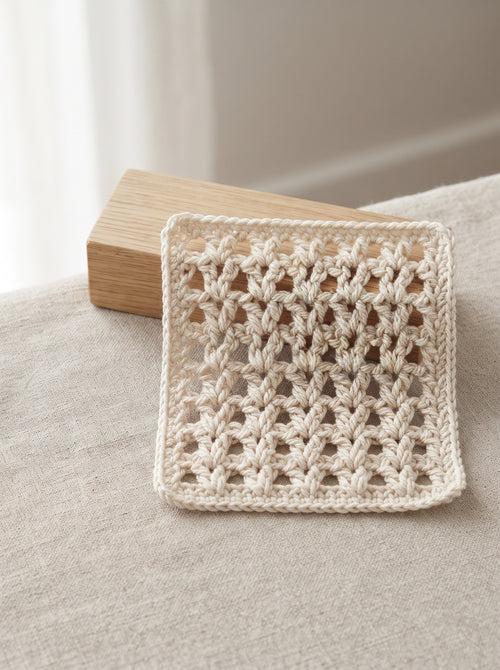
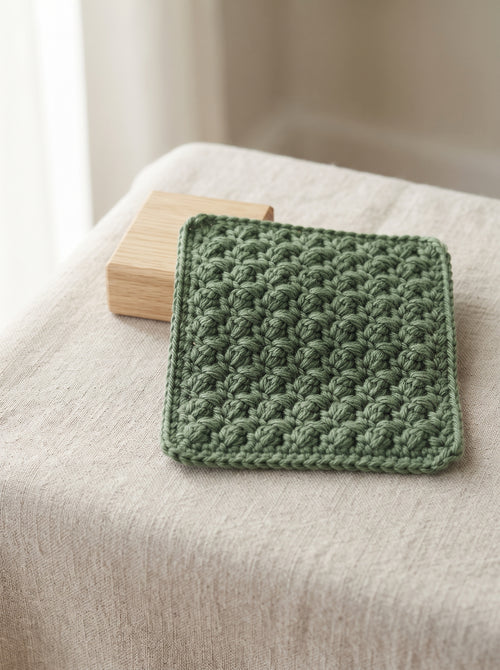
Blocking turns a good make into a polished one, especially on lacy and flat pieces. Try it on our lace doily coaster pattern, where blocking opens up the chart's petals, or on any of our free stitch cards like the grit stitch and tulip stitch. Blocked swatches make tidy dishcloths and coasters.
Still learning the stitch names? Our UK vs US terms cheat sheet and guide to reading pattern lines are a good place to start.
0 comments